World Generation as Content Production
Noise, biomes, and structures each mind one layer, and what they produce is not content but difference; the seed is infinity's rhetoric, the Far Lands its crack, and "not finding" is exploration's fuel. The design contract of procedural content is explorable, not completable.
This chapter's thesis: the design contract of world generation is "explorable," not "completable" — the generator does not produce content; it produces difference above a quality floor, the promise of infinity is cashed by the seed's rhetoric, and underwritten by the border's engineering. If players came, in finite time, to exhaust the world's differences and to downgrade "exploration" into "a checklist," this thesis would be wrong.
1The problem
Every few hours, some player posts a screenshot of a procedurally generated cliff, cave, or island to the community, the caption carrying genuine excitement. Not one of these landforms came from a designer's hand — the designers do not even know they exist. Stranger still: in principle these mountains are "all much the same," produced by one set of rules for fourteen years now — so why does it keep turning out things worth screenshotting?
Traditional content production cannot answer this. Handmade content is "a place": the designer builds a dungeon, the player consumes it once, and once consumed it is consumed. Generated content is "a set of rules": the rules themselves take no content budget; their job is to produce places without end. The former sells experience; the latter sells difference — two entirely different businesses, with entirely different design contracts. This chapter reads the contract clause by clause: where difference comes from (noise, biomes, and structures, each minding its own layer), how infinity gets promised (the seed), where the promise breaks (the Far Lands and the border), and why "not finding" is the contract's most exquisite clause.
2Why the same mountains can be looked at for a lifetime
First, correct the question's framing. It is not that "one mountain was looked at for a lifetime" — it is that the mountains are never the same. What a player looks at across a lifetime is countless mountains, each different from the last; the generation system's craft is making "different" cheap and "order within difference" stable.
Take "different" apart and it is three factors multiplied: the terrain's relief (steep here or gentle), the region's identity (desert here or snowfield), and what stands on top (villages, temples, caves opening at the surface). All three vary independently, so the number of combinations exceeds anything anyone could ever walk — this is combinatorial explosion, the shared principle behind nearly every procedural generation system. But explosion is only the necessary condition. The genuinely hard part is the second: difference must clear a quality floor. Random terrain that is merely random will generate dead zones no one could survive, chaos no one can read, and great tracts of terrain where "generated" equals "not generated." Minecraft's output is almost entirely livable, readable, and reworkable: plains flat enough to build on, mountains steep enough for drama, deep caves dangerous yet passable all the way through.
So the first clause of the design contract reads: the generator does not produce content; it produces "qualified difference." Content — what one particular cave looks like — is a product of execution; the design investment goes entirely into the rules: what counts as a mountain, what counts as a river, what kind of ground a village may appear on. The clause is falsifiable: if players ever came to feel, broadly, that "new terrain is just old terrain recolored," the supply of difference would have broken and the contract lapsed — in the years before Caves & Cliffs, the community really did voice that complaint, and the answer to it was precisely that update's rework (section four of this chapter).
3The division of labor: noise, biomes, structures
The contract's three executors, one layer each, none overstepping.
Noise governs geometry. The land's ups and downs come from a smooth, continuous noise function: take any point, and its height does not jump against its neighbors' — so mountains have ridges, valleys have a run, plains stretch naturally. Noise's contribution is continuity: it guarantees that every patch of the world "reads as terrain" rather than as random-number garbage. This is the bottom layer: it produces no meaning, only legal terrain.
Biomes govern semantics. Relief alone is not enough; players need regional identity — "this is desert," "that is taiga" — and biomes cut the continuous terrain into named climate zones, each with unified palettes and its own creatures. The biome is the generator's semantic layer: it lets players dictate the world to each other ("cross the desert heading north and you hit the snowfield"), and it makes difference anticipatable — step into a new biome and you know roughly what to expect without knowing exactly what you will find. Expectation plus suspense: that is the emotional recipe of exploration.
Structures govern narrative. Villages, shipwrecks, ruins, strongholds — these "traces of humans (or the humanlike)" are the generator's third role: telling stories. Noise and biomes produce nature; structures produce the suggestion that someone was once here: a table, a chest, a half-collapsed wall. Natural terrain is scenery; a structure is a question — who lived here? What happened? On this question the appetite for exploration changes its nature: from "seeing the sights" it upgrades to "hunting for clues."
The three layers' division compresses into one sentence: noise guarantees the terrain is legal, biomes guarantee the regions are readable, structures guarantee the world has stories. None of the three produces concrete content — they produce the conditions for content to appear. That is the precise meaning of "generation as content production": it produces the habitat of content, not content itself. How the pipeline actually runs in the machine, in what order chunks generate — the implementation volume has a chapter for that (see The World Generation Pipeline); this chapter will not unfold formulas.
Read all three layers in a single journey. You spawn in a birch forest (the biome gave you identity), head east, and the ground rises slowly (noise gave it shape); over the ridge spreads a badlands (the biome switched semantics), and on the cliff face yawns the entrance of an abandoned mineshaft (a structure gave it a story). You decide to go down — a mineshaft means wood, chests, maybe treasure, and maybe whatever it failed to seal away. Nowhere in the whole trip was anything "placed there by a designer," yet every step you read has meaning: the mountain is a mountain, the border a border, the ruin a ruin. The generator's entire craft is this: making you read the illusion of design in a place no one designed.
4The rhetoric of infinity: seeds, the Far Lands, the border
"Infinite" is Minecraft's most famous promise, and the word most in need of being taken apart.
The seed is infinity's rhetoric. Every world is uniquely determined by a string of characters (the seed): the same seed generates the same world; different seeds are never alike. The seed solves a contradiction that looks unsolvable — the world must be "different for everyone" and yet "determined for everyone." Your world is one I could never finish walking, yet your world can reappear on my computer letter for letter: just send me the seed. Hence the community grew a seed culture: sharing the seed of a perfect spawn like sharing a poem; speedrunners sifting through tens of thousands of random numbers for one flawless seed like panning for gold. The seed turned "infinite" from a statement of scale into a concrete object that can be handed over.
The Far Lands are infinity's crack. A promise is a promise, but engineering has edges. In older versions, tens of millions of blocks from home, floating-point precision ran out and the terrain began to collapse: mountains stopped being mountains, the ground split into jagged teeth, walls and void interleaved — and the community named this shattered belt the Far Lands. It was not an easter egg; it was the engineering hoof showing through the rhetoric of "infinite." And the community's response to the slip was to enshrine it: expeditions to the Far Lands became legend, and the breakage itself became scenery. The Far Lands vanished in a later rewrite of terrain generation, but the question it left is eternal: when infinity is walked to its end, what do you intend the player to see?
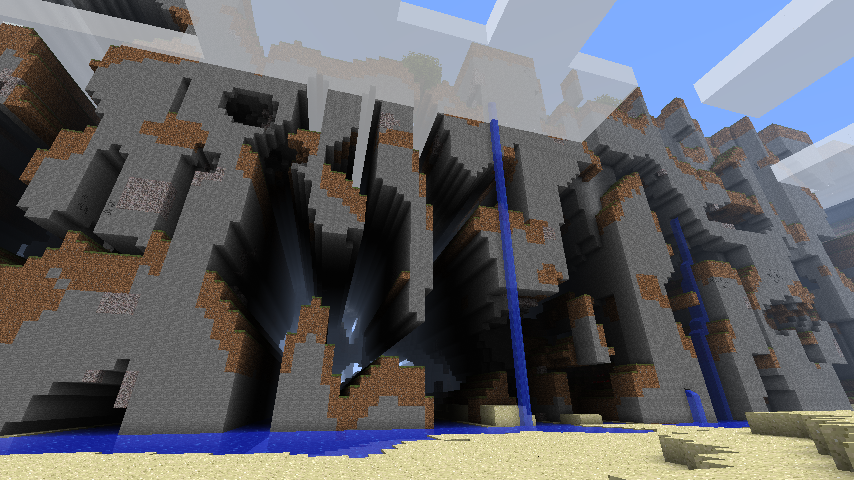
The border is infinity's backstop. Today's world has a hard edge: about thirty million blocks from the origin, the world wall stands there, and you cannot walk through it1. How far is thirty million blocks? At a player's pace, reaching it would take years of real time — the border equals infinity in experience and is finite in engineering. This is the contract at its most honest: rhetoric answers for the infinite, the border answers for the finite, and the two do not conflict. Players never need to reach the border; what players need is for the promise of "there is more" to keep holding.
5Generation as the selling point: what Caves & Cliffs proves
A dozen years after the contract was struck, one update proved it could be run in reverse: the generation system is itself a content production line — the kind that can hold a press conference.
The 2021 Caves & Cliffs update (Volume I, chapter 9 covered its governance story; see Version Evolution and Update Strategy) tore the Overworld's generation rules down and rebuilt them: the world's upper and lower limits stretched far out, caves went from narrow corridors to giant spaces at three scales, mountains towered into the clouds for the first time, ores distributed by depth. Note what this update sold — no new gameplay systems (no new combat, no new classes); what it sold was almost purely the shape of the world. Its market effect was the mass return of players a decade-plus gone: people came back not to learn new rules but to "see what the new world looks like."
The design implication runs deeper than the commercial one. The cost curve of a traditional content update is linear: one dungeon, one crew's work; content volume proportional to headcount. A generation-system update is exponential release: change the rules once, and every mountain in every new world thereafter is new content, at a marginal cost near zero. At the same time it gently devalues "old content" — the classic landforms of old worlds become discontinued editions, and new worlds await every player's exploration from the beginning. The essence of generation-as-selling-point is making "the world" itself the largest updatable asset. Every later adjustment to the generation rules (once every few years) reuses this curve; the change in update rhythm recorded in Volume I, chapter 9 rests on exactly this economics.
6"Not finding" as exploration's fuel
The contract's last clause is the most counterintuitive: the generator promises "existence," but never promises "delivery."
Strongholds hide underground with no map marker anywhere; a woodland mansion may sit tens of thousands of blocks from spawn; no minimum distance between rare structures is guaranteed. The designers could perfectly well have put everything within arm's reach — early versions did, in fact, make strongholds easier to find — but what stayed written in the contract is this: anything worth finding must actually require finding.
"Not finding" is fuel, not a defect. It sets off a three-link chain. First, navigation becomes gameplay: packing beds and food before an expedition, marking the road as you go, logging coordinates — the survival crafts Chapter 3 described — all of it means something only because "the destination is not guaranteed to be nearby." Second, information becomes community currency: seed analysis, structure-finding tools, expedition logs — the knowledge of "what is where" became a real gift and a real commodity among players (the community's finding tools are a phenomenal third-party contribution; this book records their existence as fact). Third, finding becomes an event: the first woodland mansion anyone found, the first glimpse of a stronghold library with one's own eyes — in players' memories these are "events," not "signposts"; scarcity promotes discovery into story.
The contrast holds just as firmly: if everything lies within arm's reach, the word "exploration" dies. Checklist design ("collect ten ancient debris") downgrades exploration into errand-running, because it writes "existence" and "delivery" as a single sentence. Minecraft's generation contract splits the sentence in two: the world guarantees there is, but never guarantees it gives — and the remainder is exactly the space reserved for the player's own story.
7What this chapter leaves behind
- For players: the mountain you screenshotted and the mansion you hunted for a month are the same contract cashing out on you — it never handed you content; it handed you "there is more."
- For developers: what you can take away is the generation contract's four clauses — produce qualified difference, not content; split the powers across the geometry, semantics, and narrative layers; tell infinity with rhetoric and backstop it with a border; promise "existence" and "delivery" separately. What you cannot take away is difference's compound interest over time: fifteen years of accumulated seed libraries, expedition stories, and "discontinued landforms" — however good a new product's generator is, its day one is empty.
注释
-
Minecraft Wiki, "World border" (the default border sits about 29,999,984 blocks from the origin; movement beyond it is blocked), minecraft.wiki, retrieved 2026-09-18; see https://minecraft.wiki/w/World_border ↩
Crafting, Items, and Inventory
Depth is not added to the character but to things: grid crafting makes recipe knowledge a community dialect, items are portable slices of the world, and durability and enchanting build growth into objects. Anti-RPG was a choice, not an absence.
Redstone: Physics as Programming
The electricity metaphor failed, yet logic circuits grew out of the wreckage. The game teaches nothing, so the community wrote the textbook; gates, clocks, flying machines, and computers are computation invented by players. This chapter erects the "misusable system": designers deliver physics, not a play list.